
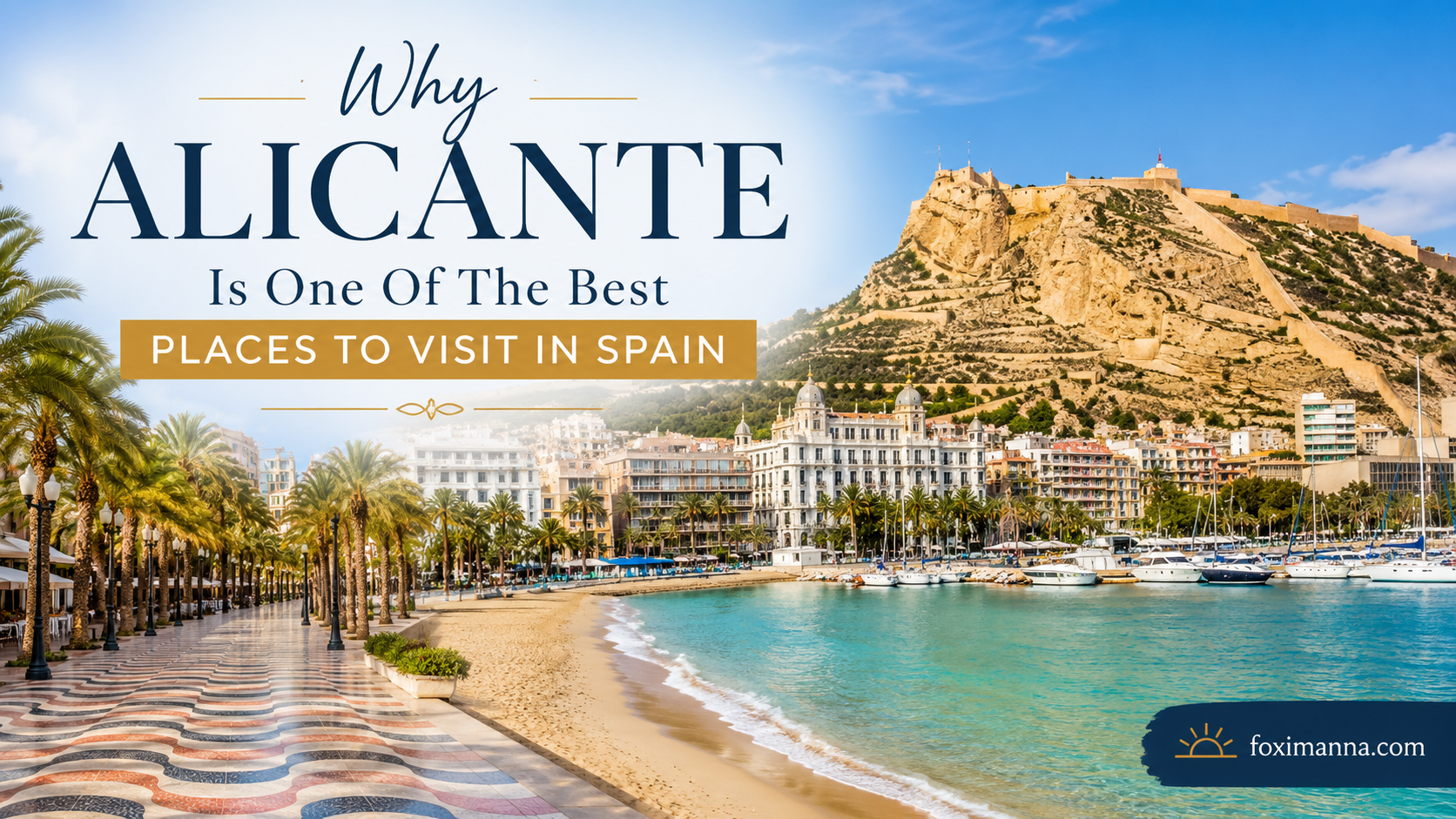
Imagine finishing work, leaving the office and reaching a golden Mediterranean beach within ten minutes. Behind you are lively shopping streets, pavement cafés and colourful buildings. In front of you is calm blue water, while a medieval fortress watches over the city from a rocky mountain.
This combination helps explain why Alicante has become one of Spain’s most appealing city-break destinations.
Located on the Costa Blanca in south-eastern Spain, Alicante offers many of the experiences travellers want from a Spanish holiday without feeling as overwhelming as Madrid or Barcelona. It has beaches, historic neighbourhoods, museums, restaurants, nightlife, reliable public transport and an international airport, yet much of the centre remains walkable and relaxed.
Alicante is not merely a resort built for tourists. It is a working Mediterranean city where residents shop, commute, meet friends, raise families and enjoy the sea throughout the year. That balance between everyday life and holiday atmosphere gives Alicante a personality of its own.
You can spend the morning exploring a castle, eat a long rice lunch on a shaded terrace, relax on the beach during the afternoon and finish the evening walking beside the marina. Few European cities make that variety feel so convenient.
The city has also attracted growing international attention as a place to live. Alicante placed third in the 2024 InterNations Expat City Ranking, behind fellow Spanish cities Valencia and Málaga. Respondents rated it particularly well for quality of life, ease of settling in and the feeling of being welcomed by local people.
However, Alicante’s popularity should not reduce it to a collection of rankings. The real attraction becomes clearer when you walk its palm-lined promenade, feel the fine sand of Postiguet Beach, wander through the old streets beneath Mount Benacantil and join local families eating outdoors late into the evening.
The experiences described in the original Alicante journey reveal a city that feels energetic without becoming exhausting, modern without losing its past and international without abandoning its Spanish identity.
This Alicante travel guide explores the city’s beaches, landmarks, food, neighbourhoods, transport connections and lifestyle. It also explains how to plan a rewarding city break and whether Alicante deserves a place on your travel or relocation shortlist.
Alicante At A Glance

Alicante is the capital of Alicante province and one of the principal cities of the Valencian Community. It sits beside the Mediterranean on a coastline internationally known as the Costa Blanca.
The city is large enough to provide the facilities expected from an important regional centre, but compact enough for visitors to understand quickly. The main railway station, shopping streets, old town, marina, Explanada de España, Postiguet Beach and the lower slopes of Santa Bárbara Castle are all relatively close together.
That convenience is one of Alicante’s greatest strengths.
In some coastal destinations, travellers must choose between staying near the beach and staying near cultural attractions. Alicante rarely forces that decision. You can book a room in or around the centre and remain within walking distance of the waterfront, historic streets, restaurants and shops.
The city is particularly suitable for travellers who want more than a conventional beach holiday. There is enough sand and sunshine for a relaxing break, but there are also museums, religious buildings, markets, public squares, parks and historic neighbourhoods to explore.
Official tourism information presents Alicante as a destination combining Mediterranean beaches, cultural heritage, gastronomy and local life. A suggested three-day itinerary includes Santa Bárbara Castle, historic neighbourhoods, the coast, shopping and a possible trip to Tabarca Island.
Alicante’s layered history also gives the city greater depth than its resort image might suggest.
Ancient settlements developed in the wider area before the Romans established Lucentum, the archaeological remains of which can still be visited outside the modern centre. Muslim rule later left a significant mark on the city, including the early fortifications on Mount Benacantil. Christian forces took control during the medieval reconquest, and Alicante subsequently developed as a strategically important Mediterranean port.
These different periods are visible in the city’s architecture. Visitors encounter medieval defensive walls, Baroque civic buildings, religious monuments, elegant avenues and contemporary apartment blocks within a relatively small area.
Alicante can also work for several different types of visitor.
Couples can enjoy waterfront dinners, sunset walks and boutique accommodation in the historic centre. Families have accessible beaches, play areas, parks and easy transport. Solo travellers benefit from a walkable centre and an active street culture. Digital workers and longer-stay visitors may appreciate the climate, international community and everyday conveniences.
The city is also a useful base for exploring other parts of the Costa Blanca. Coastal tram services connect Alicante with destinations including El Campello and Benidorm, while onward connections continue towards Altea and other towns farther north.
A typical first visit could last three or four days. This allows enough time for the castle, old town, waterfront, two beaches and several unhurried meals. A five-to-seven-day stay makes it easier to add Tabarca, El Campello, Altea or another Costa Blanca destination.
The best Alicante itinerary should not be packed from morning until night. Much of the city’s attraction comes from slowing down.
Leave time to sit beneath the palms, drink coffee in a square, browse the market, watch boats entering the harbour or return to the beach after the daytime crowds have started leaving. Alicante rewards travellers who experience its rhythm rather than treating every landmark as an item to be completed.
The Explanada And Waterfront Reveal The City’s Mediterranean Soul
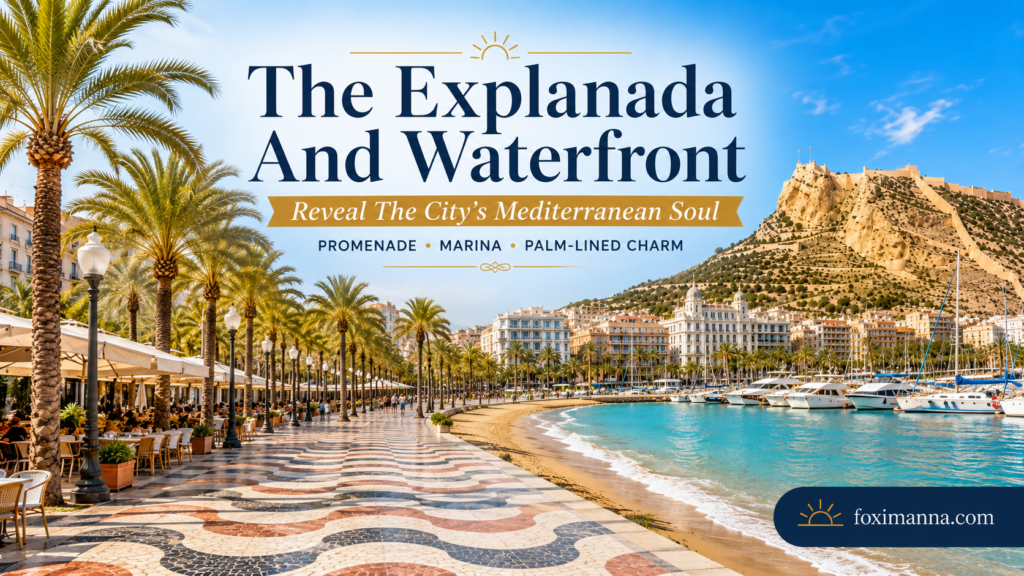
For many visitors, the Explanada de España provides the perfect introduction to Alicante.
Running parallel to the port, this broad promenade is lined with palm trees, cafés, restaurants and outdoor seating. Its distinctive wave-patterned surface creates the illusion of movement beneath your feet, reflecting the nearby Mediterranean.
According to Alicante’s official tourism authority, the Explanada’s undulating pavement contains approximately 6.6 million red, cream and dark marble tiles. The design imitates the waves of the sea and has become one of the city’s most recognisable images.
The promenade is attractive at almost any time of day.
During the morning, it can feel calm and spacious. Residents walk dogs, joggers move along the waterfront and café workers prepare terraces for the day. By lunchtime, restaurants become busier and the sound of conversation fills the avenue.
In the late afternoon, the softer light makes the palms, patterned pavement and marina particularly photogenic. After dark, families, couples and groups of friends return for evening walks.
This is not a waterfront that empties once office hours end. It functions as part of Alicante’s daily social life.
On one side of the Explanada are restaurants and city buildings. On the other are the marina, harbour and Mediterranean horizon. Expensive yachts may be moored only a short distance from local families enjoying an inexpensive evening stroll.
The setting captures the contrasts that make Alicante interesting. It is polished but accessible, urban but relaxed, historic yet clearly alive.
Visitors should resist walking along the Explanada only once. Its atmosphere changes throughout the day. An early morning visit feels very different from a warm evening when the terraces are full and the city lights reflect across the port.
The waterfront is also a useful geographical reference point. From here, you can reach Postiguet Beach, the old town, city hall, the marina and several central shopping streets without travelling far.
The marina itself is worth exploring, particularly for travellers interested in boats, sailing and coastal views. Alicante has a long relationship with the sea, and the modern harbour remains central to the city’s identity.
Close to the waterfront, you will find places to arrange boat trips and coastal excursions. One of the most popular longer outings is Tabarca Island, the only inhabited island in the Valencian Community. It lies approximately eleven nautical miles from Alicante and forms part of a small archipelago.
Boat schedules vary according to season and weather, so travellers should check departure information shortly before travelling.
The waterfront also contains several museums and cultural attractions. The Ocean Race Museum explores ocean sailing and Alicante’s role in the international race. Other galleries and exhibition spaces can provide a welcome break during the hottest part of the afternoon.
Away from the formal attractions, the simplest activity may be the most enjoyable. Buy an ice cream, find a shaded seat and watch the city move around you.
Alicante’s pavement café culture is central to the experience. Outdoor tables are not merely additional seating for tourists. They are places where local people meet, talk and spend time together.
Travellers accustomed to eating quickly may need to adjust. Service can feel unhurried because a table is often treated as somewhere to remain rather than somewhere to leave immediately after finishing.
The Explanada is especially attractive for people-watching. You might see visitors photographing the mosaic, families pushing prams, older residents meeting friends and travellers returning from the beach. Street performers and small stalls occasionally add to the atmosphere, particularly during busy periods.
For photography, try visiting shortly after sunrise or during the final hour before sunset. The light is softer, temperatures are more comfortable and fewer people may be competing for the same view.
At night, the promenade offers an easy way to end the day. It feels sociable rather than dominated by clubs or loud entertainment. Visitors can walk after dinner, stop for dessert or continue towards the illuminated city streets.
This evening culture is part of what separates Alicante from a purpose-built resort. People are not simply moving between hotels and attractions. They are using the waterfront as a shared public living room.
Postiguet And San Juan Offer Two Different Beach Experiences

Alicante’s beaches are among the strongest reasons to visit the city.
The most convenient is Postiguet Beach, located in the centre at the foot of Mount Benacantil and Santa Bárbara Castle. It begins only a short walk from the Explanada, creating one of the most attractive combinations of urban sightseeing and beach relaxation in Spain.
Official information describes Postiguet as a 900-metre urban beach with fine golden sand and a width of approximately 50 metres. Its facilities include areas for sport, children’s play and exercise, while a seasonal beach bar operates during summer.
Postiguet is not hidden behind dunes or surrounded by untouched nature. Apartment buildings, roads and city infrastructure are visible from the sand.
Yet this does not necessarily weaken the experience. The urban setting is precisely what makes the beach so practical. You can visit the castle during the morning, have lunch in the old town and spend the afternoon swimming without arranging transport.
The view is also unusual. Santa Bárbara Castle rises dramatically behind the beach, creating a background that few urban coastlines can match.
The sand is generally fine and golden, while the entrance into the water is relatively gentle. Conditions naturally vary, and swimmers should always follow the displayed flags and lifeguard instructions.
Postiguet becomes crowded during summer, weekends and major holidays. Travellers who prefer space should arrive early in the morning, visit during the shoulder seasons or consider a different beach.
Spring and autumn can be especially rewarding. The weather may still be suitable for sitting beside the sea, while the city feels less pressured than during July and August.
Postiguet also changes after dark. The illuminated waterfront, nearby restaurants and evening walkers create a calm atmosphere. Swimming at night should only be considered where permitted and safe, but walking on or beside the beach can be an enjoyable end to the day.
For a much larger beach experience, travel north-east to San Juan Beach.
The official tourism authority lists Playa de San Juan as approximately 2.9 kilometres long and 85 metres wide, with fine golden sand. Its size makes it feel more spacious than Postiguet, even when Alicante is busy.
San Juan is better suited to travellers planning a full beach day. There is more room for sunbathing, walking and sport, with facilities for activities including volleyball and other beach games.
The neighbourhood behind the beach contains apartments, restaurants, cafés and services. Some travellers choose to stay here rather than in central Alicante, particularly when beach access is more important than being close to the old town.
Choosing between Postiguet and San Juan depends on your priorities.
Postiguet is best for convenience, castle views and combining sightseeing with a few hours beside the sea. San Juan is better for space, longer walks and a more traditional beach-focused day.
Public transport makes it possible to experience both. Alicante’s TRAM network serves the coastal area, and urban bus routes also connect the centre with Playa de San Juan and El Campello. Visitors should check current routes and timetables because seasonal changes and engineering work can affect services.
Alicante has other coastal options as well.
Albufereta is smaller and may appeal to visitors staying north of the centre. The coves around Cabo de la Huerta offer a more rugged environment, although access and sea conditions require greater care. Almadraba and Saladares-Urbanova provide further alternatives, while Tabarca offers clear water and an island atmosphere.
The city tourism authority lists Postiguet, San Juan, Tabarca, Albufereta and several smaller coves among Alicante’s principal beach choices.
Beach conditions and lifeguard coverage vary by season. Official lifeguard services are more extensive during the summer, with more limited cover during selected spring periods. Travellers should verify the latest schedule before relying on supervised swimming.
Bring sun protection even outside midsummer. The Mediterranean sun can be strong during spring and autumn, especially when a sea breeze makes the temperature feel cooler than it is.
A reusable water bottle, hat, high-factor sunscreen and comfortable sandals will make a long beach day easier. Keep valuables secure and avoid leaving phones, wallets or bags unattended while swimming.
Alicante’s greatest beach advantage is not that it has the wildest coastline in Spain. It is that good-quality sand and accessible water are integrated into a functioning city.
You do not need to sacrifice restaurants, history, transport or nightlife to enjoy the Mediterranean. The sea is part of Alicante rather than something located beyond it.
Santa Bárbara Castle And The Old Town Bring Alicante’s History To Life

Santa Bárbara Castle is Alicante’s most dramatic landmark.
The fortress stands on Mount Benacantil, overlooking the city, marina and coastline. Its position made the mountain strategically valuable to the different powers that controlled Alicante.
The earliest major fortifications are associated with the Muslim period, and later Christian rulers expanded and adapted the site. Today, the castle’s walls, courtyards, towers and viewpoints allow visitors to explore several phases of the city’s history.
Alicante’s official tourism authority describes Santa Bárbara as the city’s most important monument and highlights its Muslim origins and panoramic views.
The castle is impressive from below, but the scale of its position becomes much clearer from the top. Visitors can see the grid of modern streets, the curve of Postiguet Beach, the port and the mountains beyond the city.
There are several ways to reach it.
Energetic visitors can walk uphill through the historic neighbourhoods and park areas. This approach requires effort, particularly during hot weather, but it reveals parts of Alicante that are easily missed.
The route may pass whitewashed houses, tiled walls, potted plants, narrow stairways and viewpoints opening suddenly above the rooftops. The climb becomes part of the experience rather than simply a way to reach the attraction.
Start early in the morning or later in the afternoon during warmer months. The exposed sections can feel demanding under the midday sun.
Visitors with limited mobility or less time can use transport options serving the castle area. Lift access has traditionally operated from the side facing Postiguet Beach, although opening arrangements, maintenance and charges can change. Check the castle’s official information on the day of your visit.
Once inside, allow at least 90 minutes. Those interested in photography or military history could easily stay longer.
The complex contains multiple levels, open courtyards and defensive structures. Comfortable footwear is important because some surfaces are uneven and the site involves slopes and steps.
Do not rush directly to the highest viewpoint. Lower terraces provide different perspectives across the beach and city, while quieter corners make it easier to imagine the castle’s former military role.
The historic centre below deserves equal attention.
Alicante’s old streets contain the Co-Cathedral of San Nicolás, Basilica of Santa María, city hall and numerous smaller squares. The municipal tourism authority identifies Santa María, San Nicolás, Santa Bárbara Castle and the Explanada among the city’s most significant heritage landmarks.
Alicante City Hall is an elegant Baroque building facing an attractive square. The surrounding arches, balconies and stone façades give this part of the centre a more formal character.
Nearby streets become narrower and more intimate. Small bars place tables outside, residents pass between everyday appointments and church bells echo between the buildings.
The old town feels most atmospheric when explored without a strict route. Walking uphill may reveal tiled decorations, colourful doors and unexpected views of the castle. Turning towards the sea can suddenly open a view across rooftops to the water.
One of the most photographed neighbourhoods is Santa Cruz, located on the lower slopes of Mount Benacantil. Its white houses, blue details, flowerpots and steep stairways create a village-like atmosphere within the city.
Residents live in these streets, so visitors should keep noise low, avoid blocking doorways and treat homes as private property rather than photography sets.
Another playful attraction is Calle de las Setas, commonly known as Mushroom Street. Large mushroom sculptures, bright colours and child-friendly details transformed an ordinary commercial street into one of Alicante’s more unusual public spaces.
The installation initially attracted debate, but the street subsequently became a recognisable attraction supporting nearby businesses and cafés. In visual terms, it feels closer to a storybook than the grand civic architecture found elsewhere in the centre.
A well-planned historic walking day could begin at Santa Bárbara Castle, descend through Santa Cruz, visit Santa María and San Nicolás, continue towards city hall and finish on the Explanada.
However, avoid turning the route into a race.
The pleasure comes from noticing the transitions. Within a short distance, Alicante moves from medieval fortifications to village-like lanes, Baroque buildings, commercial avenues and a modern marina.
That variety shows why the city offers much more than sunshine.
Rice Tapas Cafés And Nightlife Shape Everyday Alicante

Food is one of the best ways to understand Alicante.
The province belongs to a wider region where rice dishes are central to the local cuisine. Visitors may arrive expecting every shallow pan of rice to be called paella, but Alicante has a broader rice tradition with different broths, textures, ingredients and cooking methods.
Menus may include rice with seafood, chicken, vegetables, squid, shellfish or meat. Some dishes are dry with a crisp layer at the bottom, while others are softer, darker or more intensely flavoured.
Rather than ordering automatically, ask the restaurant what style it specialises in and whether the price is per person. Many rice dishes require a minimum of two diners and may need additional preparation time.
A good rice lunch should not be hurried. It works best as part of a long meal, ideally on an outdoor terrace with enough time to enjoy the atmosphere.
The source journey describes ordering chicken rice in a lively pedestrian street, surrounded by outdoor tables and live music. The dish arrived in a large pan with aromatic flavours, sweet peppers and a crisp base, demonstrating how eating in Alicante is as much about setting and company as the food itself.
Travellers should also try Alicante’s tapas culture.
Tapas menus make it possible to share several smaller plates rather than committing to a single main course. Options vary, but visitors may encounter grilled vegetables, croquettes, potatoes, seafood, cured meats, cheeses and local specialities.
Those with dietary, religious or allergy requirements should ask clearly about ingredients. Rice dishes and sauces can contain meat stock, shellfish, alcohol or pork even when these are not obvious from the English description.
Central Alicante contains restaurants for many budgets. Waterfront venues may charge more for their location, while streets farther from the marina can offer better value.
A simple way to choose somewhere to eat is to examine where local customers are sitting. A short translated menu and busy dining room can sometimes be a better sign than a large display of tourist photographs.
The Mercado Central is another useful stop for food lovers. Markets show the ingredients behind the region’s cuisine and provide a different experience from restaurant dining. Depending on the stall and opening time, visitors may find fruit, vegetables, baked goods, spices, meat, fish and prepared snacks.
Visit earlier in the day because traditional markets are not necessarily designed around late-evening tourist schedules.
Coffee culture is equally visible. Outdoor cafés appear across the centre, providing places to rest between attractions. Ordering a coffee and watching life in the square is not wasted sightseeing time. It is one of the clearest ways to experience the city.
Alicante’s nightlife is varied rather than concentrated into one identity.
Around the old town and central streets, visitors will find traditional bars, modern cocktail venues, pubs, music spaces and late-night restaurants. The atmosphere can be busy without always becoming chaotic.
One of the most distinctive features of Spanish evening life is how different generations share public spaces. At 10 or 11 at night, you may see families walking, couples eating, children enjoying ice cream and groups of friends beginning their evening.
This can feel surprising to visitors from places where city centres become quieter or less family-oriented after dark.
Alicante’s late dining timetable requires adjustment. Restaurants may be relatively quiet at the time British travellers normally eat dinner, becoming busier later in the evening.
Those who prefer earlier meals should check kitchen hours rather than assuming every venue serves continuously.
The area near the cathedral and old town becomes particularly lively after dark. Historic façades and narrow streets create an attractive setting for an evening walk, even for travellers who are not interested in clubs.
The Explanada and beach offer a calmer alternative. After dinner, you can return to the waterfront, walk beside the palms or sit near the sea.
Normal urban precautions remain important. Keep bags closed, avoid displaying large amounts of cash and remain aware of your surroundings in crowded nightlife areas. Feeling relaxed should not mean abandoning common sense.
Alicante also hosts major festivals that can transform the city. The best known is Las Hogueras de San Juan, or the Bonfires of Saint John, when large artistic monuments are displayed before the festival’s fiery conclusion. Some constructions can reach approximately 12 metres in height.
Festival periods provide unforgettable energy but also bring crowds, noise, road closures and higher accommodation demand. Book early when travelling for a major event.
Whether you prefer a quiet café, long rice lunch or lively evening, Alicante’s food culture encourages people to spend time outdoors and together.
That social atmosphere is one of the city’s most valuable attractions, and it costs nothing to observe.
How To Reach Alicante And Explore The Costa Blanca

Alicante is one of the easiest Mediterranean cities to reach from Britain and northern Europe.
Alicante-Elche Miguel Hernández Airport is a major international gateway serving the Costa Blanca. Aena reported approximately 20 million passengers and 228 routes during 2025, demonstrating the airport’s importance to the region.
Direct flights operate from numerous European cities, although routes and frequencies change seasonally. Travellers should compare not only ticket prices but also baggage rules, airport arrival times and transport costs after landing.
The airport is outside central Alicante, but the C6 airport bus connects the terminal with the city. Its route includes central stops and Alicante railway station, and contactless payment is available on the service.
Check the latest timetable before travelling, particularly for an early flight or late arrival.
Taxis and private transfers are also available. They may be more convenient for families, larger groups, travellers with heavy luggage or visitors staying outside the centre.
Alicante is well connected by rail. Renfe operates high-speed and long-distance services between Alicante and Madrid, with some direct journeys taking roughly two and a half hours depending on the train. Official schedules should always be consulted for the chosen date.
Rail travel can be an attractive option for combining Alicante with Madrid, Cuenca, Albacete or other Spanish destinations. Avlo, Renfe’s lower-cost high-speed brand, also serves the Madrid to Alicante corridor.
Within Alicante, walking is often the best form of transport.
The main central attractions are close enough that visitors may not need a car. Driving in unfamiliar one-way streets, finding parking and navigating restricted zones can add unnecessary stress to a short city break.
The local bus and TRAM networks cover destinations beyond comfortable walking distance.
TRAM d’Alacant serves central underground stations before continuing towards beaches, residential districts and coastal towns. Line 1 links Luceros in Alicante with Benidorm, while other lines serve El Campello, Playa de San Juan, Sant Vicent del Raspeig and additional areas.
The coastal journey can be an enjoyable excursion in its own right. Instead of hiring a car, visitors can use the tram to reach a different beach or spend a day in another Costa Blanca town.
During selected summer weekends, the network may operate special night services on several lines. These arrangements are seasonal, so they should be verified rather than assumed.
The system also has accessibility features. TRAM d’Alacant states that its stops are adapted for people with reduced mobility and wheelchair users, while underground stations include lifts and escalators. Individual travellers should still check whether any temporary disruption affects their required route.
Several easy day trips can be considered from Alicante.
El Campello offers a more relaxed coastal atmosphere and can be reached by tram.
Benidorm provides large beaches, entertainment, theme parks and an energetic resort environment. It feels very different from Alicante despite being within the same coastal region.
Altea is known for whitewashed streets, hillside views and a picturesque old town. The journey takes longer, but it can be combined with other northern Costa Blanca stops.
Tabarca Island offers swimming, seafood and a break from the urban environment. Boat schedules depend on season and conditions.
Villajoyosa is recognised for its colourful seafront buildings and chocolate-making history.
Travellers with a week in Alicante could combine three or four days in the city with two coastal excursions and one unplanned rest day.
A rental car becomes more useful for inland villages, hiking areas and remote beaches. Before hiring, examine fuel policies, deposits, excess charges, parking rules and insurance exclusions.
Do not assume the lowest advertised price represents the final cost.
For accommodation, the city centre suits first-time visitors who want to walk to most attractions. The old town offers atmosphere but may be noisy at night. The waterfront provides views and convenience, often at a higher price. San Juan suits beach-focused holidays, while areas around the railway station can be practical for onward travel.
Book earlier for summer, major festivals and school-holiday periods. Prices and availability can change considerably according to demand.
Is Alicante Worth Visiting Or Moving To

Alicante is absolutely worth considering for a Spanish city break.
It provides a rare balance of beach access, historic character, local food and practical transport. Travellers can enjoy a complete holiday without hiring a car or travelling long distances between attractions.
It is particularly suitable for people who find Barcelona too intense, Madrid too far from the sea or smaller resorts too limited.
Alicante sits comfortably between those extremes.
The city is not without disadvantages. Postiguet Beach becomes crowded during peak summer. Central accommodation prices rise when demand is high. Some streets are heavily influenced by tourism, and construction or traffic can interrupt the postcard image.
July and August can also feel extremely hot, especially during the walk to Santa Bárbara Castle. Visitors who struggle with high temperatures may prefer spring or autumn.
April, May, late September and October can offer an attractive balance of warmer weather and more manageable crowds. Winter is generally quieter, making it appealing for sightseeing and longer stays, although beach weather is less dependable.
No month guarantees perfect conditions. Travellers should check the short-term forecast shortly before departure and pack for changing evenings, wind and occasional rain.
Alicante also works well for different budgets.
Free or inexpensive activities include walking the Explanada, exploring the old town, visiting public squares, relaxing on the beach and enjoying viewpoints. Spending rises according to accommodation, restaurant choices, excursions and nightlife.
Budget travellers can stay farther from the waterfront, use public transport, shop at supermarkets or markets and choose a mixture of restaurant meals and self-catering.
Mid-range visitors will find plenty of hotels and apartments, while luxury travellers can choose sea-view accommodation, private tours and marina-side dining.
The question of moving to Alicante requires more caution than planning a holiday.
The city’s strong performance in the 2024 InterNations survey suggests that many international residents value its climate, leisure opportunities and welcoming atmosphere.
However, enjoying a destination for four days does not prove that it will suit everyday life.
Anyone considering relocation should investigate residency rights, visas, taxation, healthcare, employment, school options, language requirements and housing costs through official professional sources.
Property prices shown in estate-agent windows offer only a snapshot. Asking prices can vary widely by neighbourhood, property condition, floor, outdoor space and distance from the coast. Predictions that prices will double within a specific number of years should be treated as speculation rather than reliable financial guidance.
Rent for several weeks before buying. Experience the neighbourhood during the morning, afternoon and late evening. Test the commute, visit supermarkets, examine noise levels and understand what the area feels like outside the holiday season.
Learning Spanish will also make a long-term stay more rewarding. English is widely understood in parts of the tourism industry, but everyday administration, healthcare appointments, local relationships and employment become easier when residents can communicate in Spanish.
For visitors, the verdict is much simpler.
Alicante deserves greater recognition as a complete Mediterranean destination. Its attraction does not depend on one monument or one beach. It comes from how easily the different parts work together.
You can begin the day on the patterned Explanada, climb through old neighbourhoods to a medieval fortress, swim beneath the castle, share a rice dish on a busy terrace and walk beside the Mediterranean at night.
The city delivers history without demanding a museum-only holiday. It delivers beach life without isolating visitors inside a resort. It offers nightlife without requiring every evening to become a party.
Most importantly, Alicante feels liveable.
Even during a short visit, it is easy to imagine a daily routine here. Coffee beneath the palms. Work in the centre. A tram to the beach. Dinner in a square. An evening walk beside the water.
That sense of possibility may be the strongest reason people continue visiting Alicante and, in some cases, begin wondering what life would be like if they stayed.
Disclaimer
The information provided in this article is for general informational and educational purposes only. While every effort has been made to ensure the accuracy of the information at the time of writing, travel conditions, entry requirements, opening hours, ticket prices, local regulations, and accessibility may change without notice.
Readers are encouraged to verify all travel information with official tourism boards, government agencies, airlines, accommodation providers, and local authorities before making travel plans or bookings.
The destinations featured in this article are based on their historical, cultural, natural, and tourism significance. The opinions expressed are for informational purposes only and should not be considered professional travel, legal, health, safety, or financial advice.
FoxiManna.com and its authors are not responsible for any losses, injuries, inconveniences, travel disruptions, or damages that may result from the use of information contained in this article. Travelers are responsible for conducting their own research and making informed decisions based on their individual circumstances.
By using this website and reading this article, you agree that any reliance on the information provided is at your own risk.